
Visual identity
On this page
Use the Prism identity across repositories, research areas, the Simulation Lab, and meta-research. Find editable logos, headers, social images, and the visual style sheet in the identity kit.
Name and graphics#
- Use Open Source Research Initiative and OSRI.
- Use the descriptor Human-driven Agentic-Powered-Research.
- Derive avatars, headers, icons, and publication cards from the same logo and layout rules.
- Keep editable sources. Use SVG for vector graphics, PNG for raster images, and PDF for print copies.
- Record creators, versions, font dependencies, and reuse terms.
Prism application#
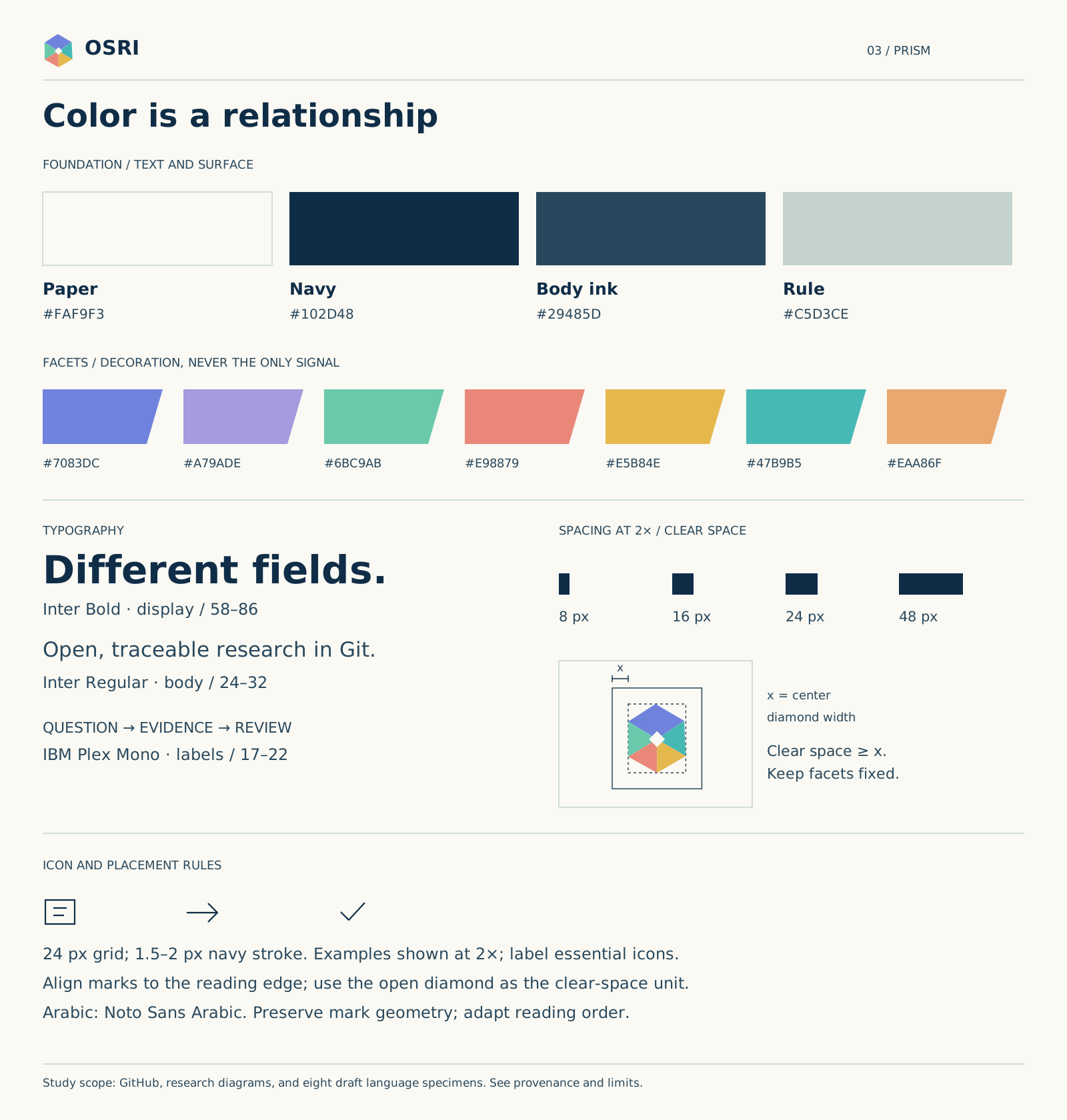
- Keep the facets and the central open diamond in their supplied arrangement. Do not mirror the mark for right-to-left text.
- Leave clear space at least as wide as the central diamond around the mark. Place the mark at the reading edge where the layout permits.
- Use the symbol alone for small avatars. Use the navy-ground avatar or the monochrome symbol where the light-colored facets would lack contrast.
- Use paper
#FAF9F3for a light surface, navy#102D48for primary text, and ink#29485Dfor supporting text. The style sheet records the full palette. - Use Inter for Latin headings and body text and IBM Plex Mono for short labels. Choose a suitable supporting font for each script. Font files and notices are in the identity kit.
- Keep facet colors decorative. Do not use color alone to communicate status. Check contrast in each actual use.


Readability#
- Keep README instructions and navigation as selectable text.
- Give informative graphics alt text and complex figures a text explanation.
- Use fonts that support the required scripts. Allow translated labels to wrap.
- Check small screens, light and dark backgrounds, monochrome output, and right-to-left layouts.
- Show status with words or shapes as well as color.
- Use at least 4.5:1 contrast for body text.
- Use at least 3:1 contrast for essential graphical elements against adjacent colors.
Research figures#
Label axes, units, uncertainty, and sources. Preserve formal notation and relationship direction. Label illustrations and synthetic examples. State publication and review status accurately.
Keep plotting code and model sources with the research project. Follow the open-format guide and the publication venue's requirements.